ACSL Begins AI Development for Autonomous and Distributed-Control UAVs -Selects Preferred Networks as Subcontractor to Develop AI-Enabled Small Drones-
- ACSL is conducting R&D on small drones utilizing AI under NEDO’s K Program, “Autonomous and Distributed Control Technology for Small Unmanned Aerial Vehicles.”
- ACSL has commissioned Preferred Networks, which develops AI-based solutions and products, to develop software enabling advanced autonomous and distributed control.
- ACSL aims to establish next-generation autonomous control technologies using AI to enhance the social acceptance and convenience of drones.
ACSL Ltd. (ACSL) hereby announces that, under the adopted K Program project “Autonomous and Distributed Control Technology for Small Unmanned Aerial Vehicles,” it has commissioned Preferred Networks, Inc. (Head Office: Chiyoda-ku, Tokyo; CEO: Daisuke Okanohara; PFN) to develop software enabling advanced autonomous and distributed control using AI, thereby accelerating the integration of AI technologies into small drones.
PFN develops solutions and products related to AI and robotics and possesses a domestically developed foundation model for generative AI. By collaborating with PFN, ACSL will further promote the advancement and added value of drones through AI technologies.
■About the K Program: “Autonomous and Distributed Control Technology for Small Unmanned Aerial Vehicles”
In October 2025, ACSL was selected* by the New Energy and Industrial Technology Development Organization (NEDO) as the contractor for the project “Autonomous and Distributed Control Technology for Small Unmanned Aerial Vehicles (Phase 2)” (the Project) under the research and development concept “Autonomous and Distributed Control Technology for Small Unmanned Aerial Vehicles” (the R&D concept) within Key and Advanced Technology R&D through Cross Community Collaboration Program (the K Program), for which NEDO issued a public call for proposals.
The K Program aims to foster advanced and critical technologies essential for maintaining Japan’s international competitiveness. Under this Project, ACSL will work on the development of an initial prototype of a small unmanned aircraft equipped with software capable of advanced autonomous and distributed control.
In collaboration with PFN, ACSL will carry out the following technological developments to establish next-generation small drone technologies:
・Automated flight plan generation using generative AI, with dynamic replanning in response to environmental changes
・Advanced object recognition and obstacle avoidance using AI, surpassing traditional obstacle detection
・Automated inspection functions in which AI detects early signs of aircraft anomalies
These efforts aim to establish the advanced autonomous control technologies required for next-generation small drones. By further improving flight safety and reliability, ACSL aims to enhance the social acceptance and convenience of drones.
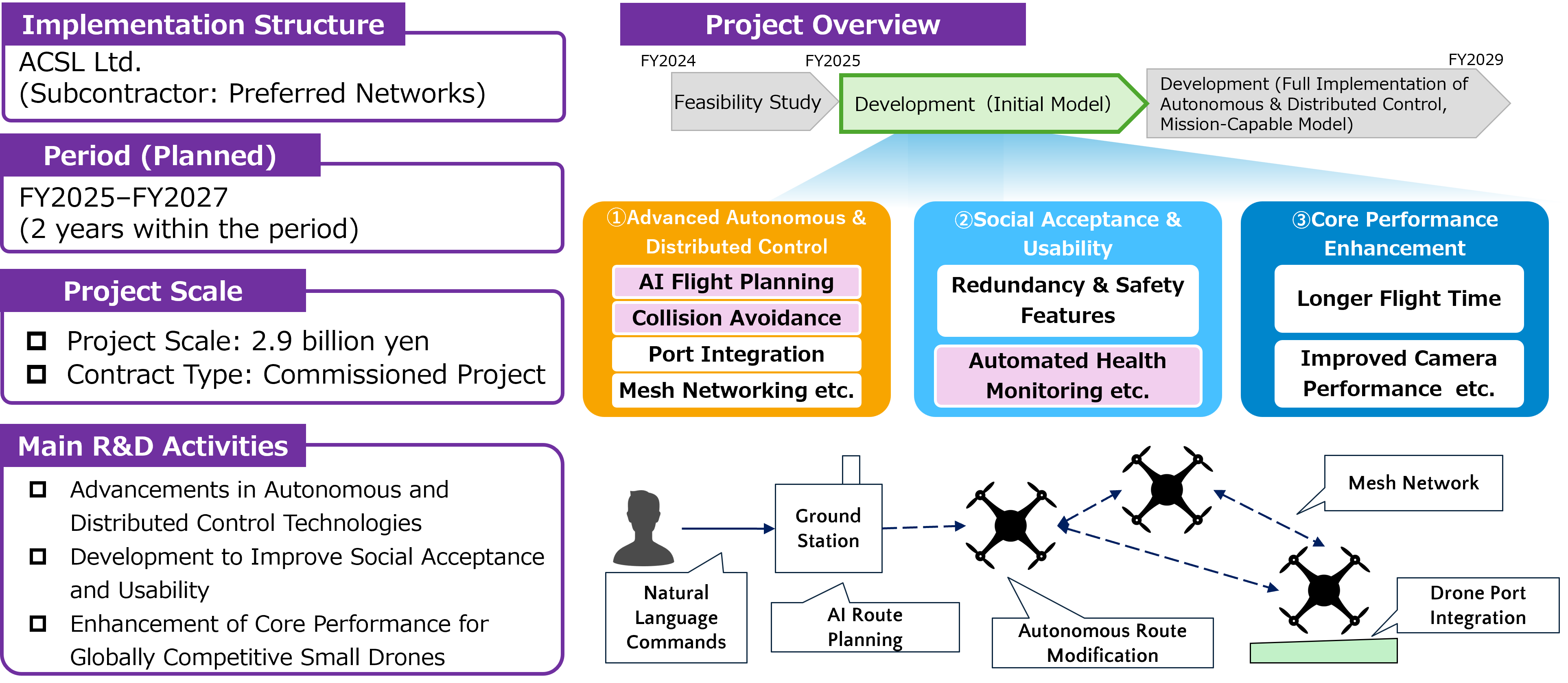 Overview diagram of the K Program “Autonomous and Distributed Control Technology for Small Unmanned Aerial Vehicles”
Furthermore, under its mid-term plan “ACSL Accelerate FY26,” ACSL aims to grow into a “trusted global manufacturer supporting safety and security” and has identified six strategic priorities. This initiative is a core component of the priority area of “drone evolution with advanced technologies.” The AI‑based autonomous control technologies developed through this project will serve as key technologies for ACSL’s next‑next‑generation small drone scheduled for release in 2028. By establishing these foundational technologies for future drones, ACSL will further accelerate the advancement of drone technologies and the expansion of their industrial applications.
ACSL remains committed to accelerating the social implementation of domestically produced drones through advanced research and development and aims to expand their use across a wide range of industries in Japan and abroad.
Please click here for the PDF